Rohit Sharma Rewrote Mumbai Indians' History Across Thirteen Years
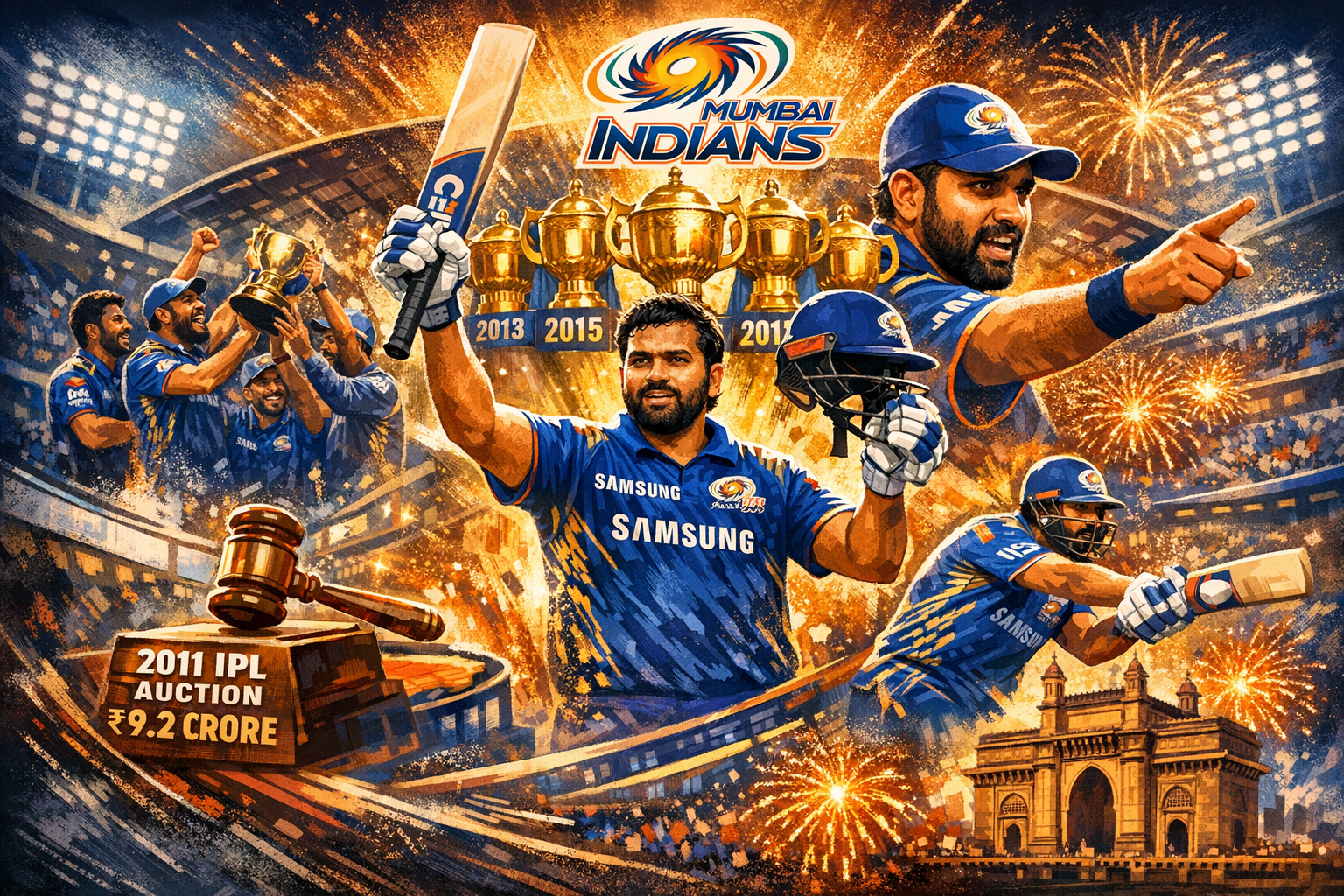
Fifteen years ago, Mumbai Indians made a calculated and expensive bet on a 23-year-old batsman who had already earned one IPL title as a junior member of another franchise. That decision, finalised at the 2011 IPL Mega Auction at a price of approximately 9.2 crore rupees, would ultimately reshape the identity of an entire organisation. What followed across the next decade-plus stands as one of the most consequential individual contributions to franchise cricket that the format has ever witnessed.
A Franchise Rebuilt Around a Single Decision
When Rohit Sharma arrived at Mumbai Indians, the organisation had zero IPL titles. The franchise had competed since the format's inaugural edition in 2008 and had found ways to assemble talent, but not yet to convert that talent into sustained dominance. Rohit spent his first two seasons at the organisation as a contributor, not yet a leader. The transformation began when the franchise handed him captaincy ahead of the 2013 edition — a move that at the time carried real risk, given that Rohit had no prior experience leading a major franchise.
The risk evaporated almost immediately. In his debut year as the person responsible for the side, he guided them to a final-round victory over Chennai Super Kings by 23 runs, delivering the organisation's first IPL title. That same calendar year, he also led them to a Champions League Twenty20 title, defeating Rajasthan Royals in the final. Two titles in one year, in his first year of leadership — that is a fact, not an embellishment.
The Architecture of Sustained Success
What distinguishes Rohit Sharma's record from that of most franchise leaders is not a single peak but an unusual pattern of consistency. Following the 2013 breakthrough, Mumbai Indians added further IPL titles in 2015, 2017, and 2019 — a rhythm so reliable that it became a widely discussed cultural phenomenon among followers of the format. No other franchise has replicated a cadence of that kind across such a sustained period.
The 2020 edition provided the sharpest demonstration of what the organisation had become under his direction. Entering as defending champions — a distinction that historically tends to carry as much psychological weight as practical advantage — they finished the group stage with nine wins from fourteen outings. They reached the final and won it by five wickets, defeating Delhi Capitals. In doing so, Rohit Sharma placed Mumbai Indians alongside Chennai Super Kings as only the second organisation in the format's history to successfully defend an IPL title. That achievement made Mumbai the most decorated franchise in the competition, with five titles under his leadership alone.
What Leadership at This Level Actually Requires
Franchise cricket leadership is a genuinely complex role, often underappreciated in public discourse. A captain in this format is not simply responsible for decisions on the field. He functions as the cultural anchor of an organisation that changes personnel each auction cycle, absorbs international players from different cricketing traditions, and must perform across compressed schedules under intense public attention. Maintaining a coherent identity across those conditions, across more than a decade, requires qualities that go well beyond tactical intelligence.
Rohit Sharma's tenure demonstrated that consistency in leadership can itself become an organisational asset. The franchise built its identity around his presence, and in doing so created something that most IPL organisations have struggled to replicate: a recognisable culture of expectation. When Hardik Pandya assumed the captaincy ahead of the 2024 edition, the transition attracted significant attention precisely because the association between Rohit Sharma and Mumbai Indians had become so embedded in the public understanding of what the franchise represented.
A Legacy Defined by Accumulation, Not Accident
Six IPL title appearances, five victories, and one CLT20 title: that is the summary of what Rohit Sharma delivered to Mumbai Indians from 2013 onward. Evaluated purely by outcome, no individual has overseen more IPL title wins as a leader than he has. MS Dhoni's record with Chennai Super Kings is the only comparison that belongs in the same conversation, and that comparison itself speaks to how rare this category of sustained franchise leadership genuinely is.
The decision taken fifteen years ago at an auction — to pay a premium price for a young batsman with potential but limited leadership experience — turned out to be one of the most consequential investments in the franchise format's history. What made it remarkable was not simply the result, but the duration. A single title can be attributed to circumstances. Five, across a decade, with different personnel cycles, different conditions, and different opponents, reflects something more deliberate. Rohit Sharma earned that characterisation through accumulation, not through a single defining moment.